.svg)
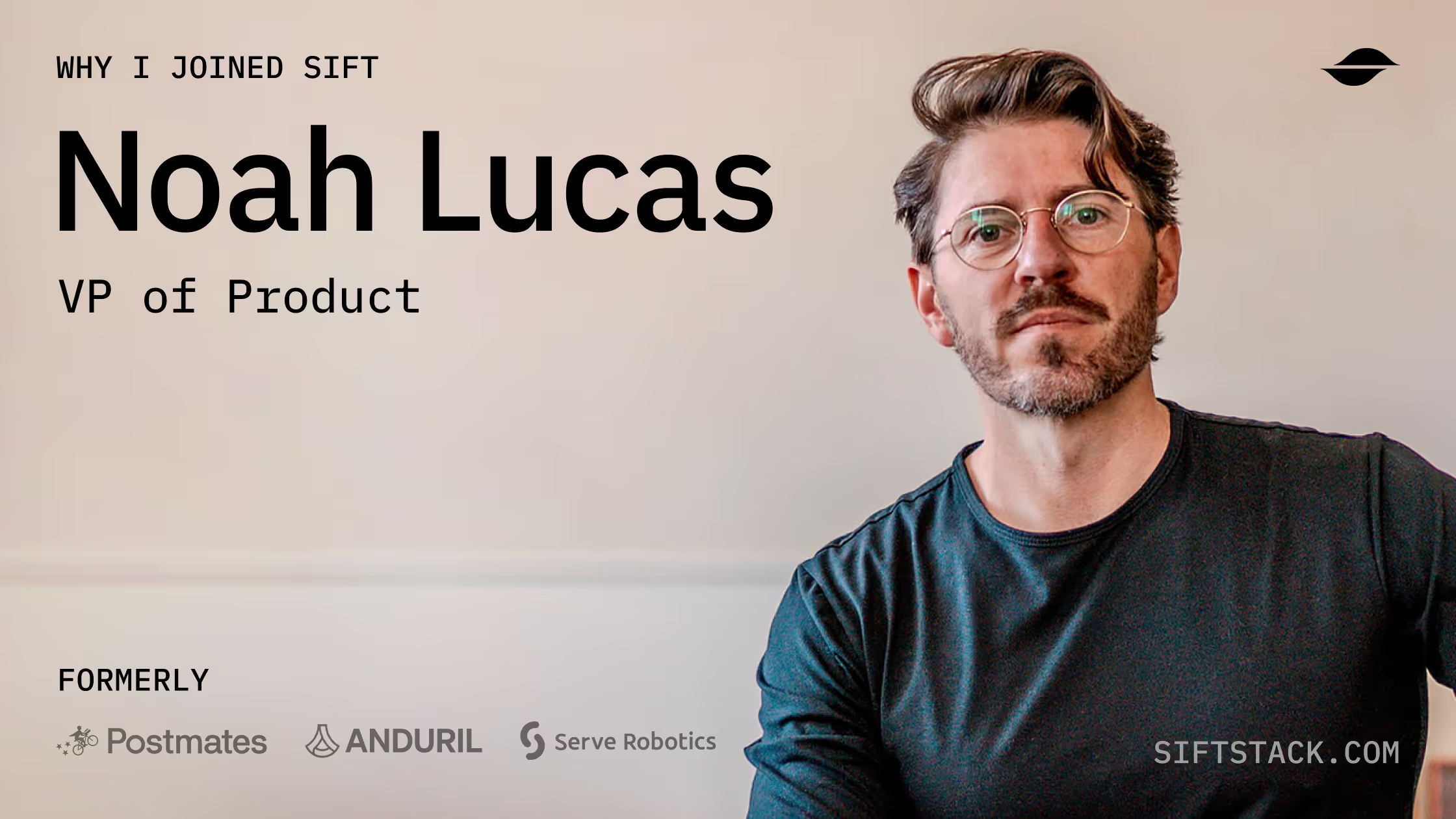
For fifteen years I've been building distributed systems that move through the physical world. Each one ran software-defined hardware at the edge on a vertically integrated data platform treated as critical infrastructure. Across consumer, enterprise, defense, and now the frontier, I came to see sensor intelligence as a competitive advantage: sensors are where physics meets technology, and the leverage they create scales with how fast telemetry becomes actionable intelligence. The complexity, volume, and operational impact of sensor intelligence have grown exponentially, and so has the number of software-defined machines. The tools have not kept up. I joined Sift to accelerate our customers as they build and operate the most advanced machines on Earth and on orbit.
Following the signal
At Postmates, sensor intelligence powered our real-time logistics network at the city block, in the cloud. At Serve Robotics it tightened to the sidewalk, fused with simulation, and made L4 autonomy possible, critical infrastructure that both the autonomy stack and the business depended on. At Pendulum it sharpened to the centimeter and moved to the edge with no cloud at all, where I led joint field exercises in electromagnetic-warfare environments at White Sands, fusing sensors for geolocation and watching neural networks personalize to a warfighter's stride. At Anduril it held that centimeter precision across every domain, air, land, sea, subsea, and mixed reality, where I led the geospatial data platform for a heterogeneous fleet of AI-native assets and connected simulation to a space-to-edge architecture in live missions.
Precision tightened from a city block to the centimeter. Compute became distributed from space to cloud to edge. Each step took me closer to the signal and raised the cost of getting it wrong.
The structural thesis
Right now, most teams treat telemetry as an open loop. They lose the compounding advantage because the infrastructure forgets. Data lives in one tool, context lives with domain experts, and over time nobody can reproduce the output, much less build on it. That is the gap.
The pattern is accelerating across frontier engineering. The companies building the most advanced machines are crossing from validation into live operations and scaling production at the same time, which is exactly when the cost of forgetting compounds fastest. As the space economy grows and assets operate on orbit, around the Moon, and across cislunar space, what used to take days or weeks now has to happen in near real time. The reasoning behind a decision has to move to the edge, as close to the asset as possible. Decisions have to happen at machine speed and machine scale without sacrificing observability, traceability, governance, and engineering judgment.
Why Sift
Sift's sensor intelligence infrastructure turns raw telemetry into actionable, governed decisions our customers define once and repeat at scale. Today, a test ends and an anomaly turns up two hours into the run. By the time the team has stitched logs from four tools and reconstructed who saw what, engineers have lost days, and none of that intelligence compounds across runs, let alone across the lifetime of the asset.
With Sift, telemetry streams in real time for live operations, and anomalies surface in context, with prior decisions and the full historical record one query away. The evidence is stored and the decisions are machine-readable, so AI can reason over them and act, sharply compressing the engineering workflow. The decision trail stays attached to the data, and the next program starts with the benefit of what the organization already learned.
Teams like ULA, Astranis, K2 Space, Impulse, and Inversion trust Sift with their most consequential programs right now, as they move from building to flying to operating at scale. Sift captures both their engineering decisions and the raw telemetry behind them, so time-to-insight drops dramatically. Work that used to take days now takes a fraction of the time, and the intelligence compounds across every run and across the full lifetime of the asset.
I joined as VP of Product to accelerate the Sift mission for our customers building and operating at the frontier.
Let’s build
I have roles open for builders who have felt the pain firsthand: designing, validating, deploying, and maintaining advanced systems at the limits of what's possible. Our customers are moving fast in space, robotics, autonomy, and physical AI. If you have built in any of those worlds, you already know the problem. If you have built infrastructure for edge-first, software-defined assets running in degraded and denied environments, even better.
The teams I'm building at Sift get excited by this. If sensor intelligence infrastructure for rockets, satellites, robots, and autonomous vehicles has been the throughline of your career, I'm hiring across product, design, and engineering at careers.siftstack.com.