.svg)
Joining Sift to empower hardware teams
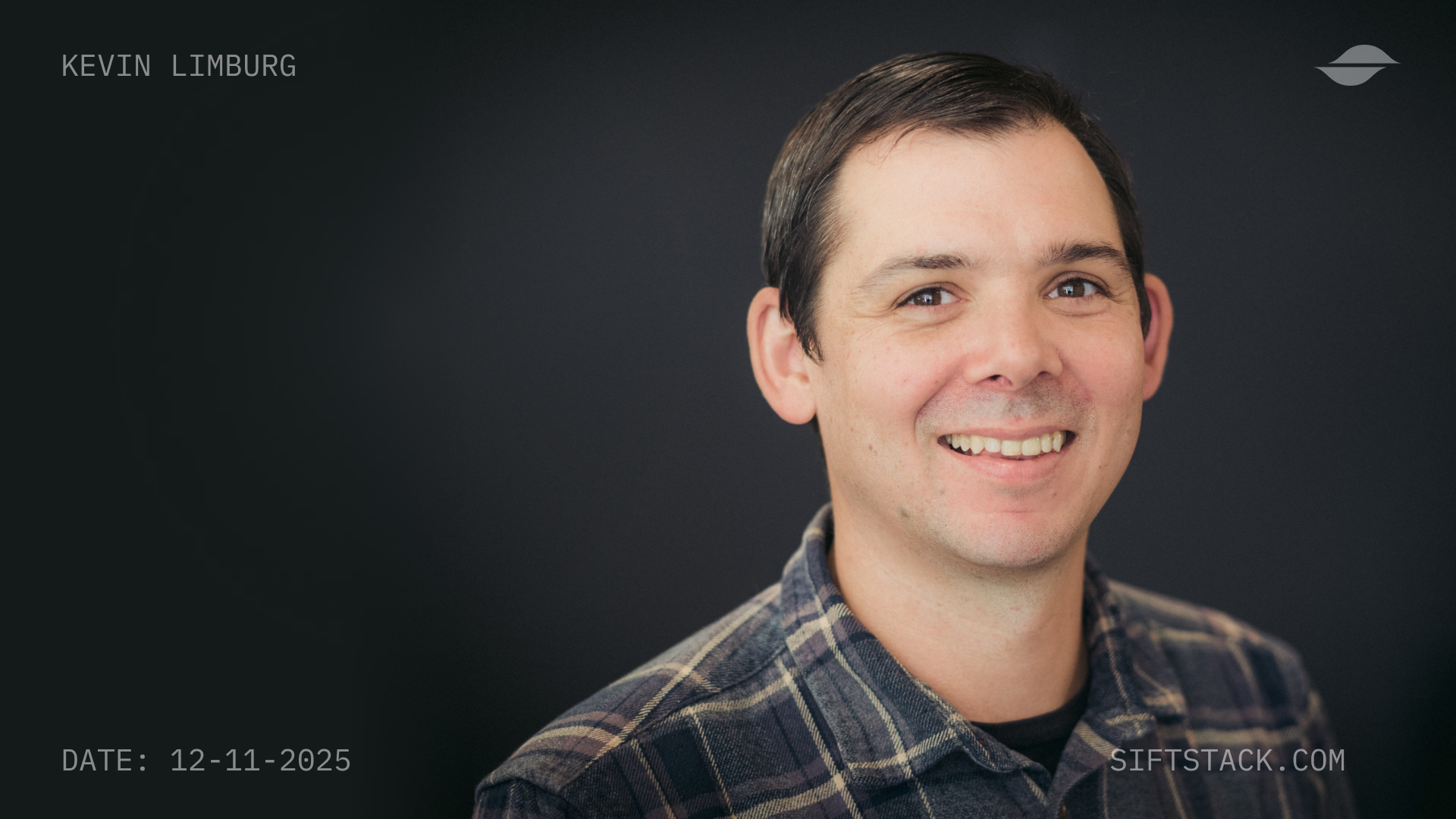
Kevin Limburg is a Software Engineering Manager at Sift, where he helps lead a team responsible for core observability capabilities used by Sift customers across testing, production, and operations. Before joining Sift, Kevin led fleet management, UI, test and infrastructure teams at Parallel Systems, a startup building autonomous rail vehicles. Prior to that, he worked on infrastructure and tooling at SpaceX. As a former Sift customer, Kevin brings both deep technical empathy and firsthand experience with how Sift enables better engineering decisions.
From Sift customer to builder
When I was at Parallel Systems, we were building autonomous battery-electric freight vehicles to modernize the rail industry. Our test operations produced a huge volume of telemetry, and we needed a way to make sense of it quickly and reliably. That’s when we found Sift. We had been spending significant time and resources maintaining a custom-built observability stack, but it wasn’t keeping up with the pace of our development. Choosing Sift over continuing to build in-house was a great strategic decision for us.
It was the first solution we used that actually felt like it was made for hardware engineering teams. We used it to compare simulation results to real-world tests with the vehicles to understand sensor failures, and validate control algorithms across test runs. When the opportunity came up to join the team behind it, I couldn’t pass it up.
Before that, I worked at SpaceX, focused on infrastructure and tooling. Parallel had that same fast-paced, high-rigor environment, and many of us came from similar backgrounds. What’s unique about Sift is that I now get to work alongside more than sixteen former SpaceX colleagues again. They’ve brought with them a shared culture of urgency, precision, and hands-on problem solving. But this time, I wasn’t just supporting one company. I’d get to help build something that could accelerate progress for teams like the one I just left. That felt meaningful.
Telemetry meets test results
One of the projects I’m proudest of is the new Test Results capability. It’s designed to help hardware teams immediately correlate failing test outcomes with the underlying telemetry that explains why something went wrong.
If you’ve ever tried debugging a sensor fault on a test stand, you’ve probably seen a vague failure message. Something like, "sensor out of range", with no further context. But Sift lets you click straight from that result into the exact signal trace, waveform, or state transition that occurred at that moment. You're not just reading a log, you’re analyzing the full behavior of the system.
What makes this powerful is how seamlessly it connects structured data such as test definitions, configurations, and outcomes with unstructured telemetry and time series data. That bridge is where most tools fall short. By making it easy to move between these worlds, we’re helping teams close the loop faster, catch regressions earlier, and understand their systems more deeply.
I’ve built similar tools internally at past companies, and it’s always hard to get right. Seeing customers adopt this so quickly, and rely on it to make real engineering decisions, has been one of the most rewarding parts of the job.
What makes this powerful is how seamlessly it connects structured data such as test definitions, configurations, and outcomes with unstructured telemetry and time series data.
Building for engineers, moving with intent
One of the first things that stood out to me at Sift was the talent density. The engineers here are deeply product-minded and mission-driven. People aren’t just writing code to spec, they’re thinking about how to make life easier for the hardware teams in the field. That shows up in how we build, how we prioritize, and how we lead.
Customer experience isn’t a checkbox for us. It matters because our users are debugging launch failures, scaling production lines, or trying to get a test campaign back on track. The product has to be fast. It has to be intuitive and it has to work when it counts.
As a manager, I think one of the most important things I can do is reduce complexity. At Sift, we move quickly, but we also think carefully about tradeoffs. We talk a lot about balancing a bias for action with long-term thinking. I try to lead in a way that respects both. Move fast, but not blindly. Keep it simple. Always ask why before we ship.
Getting motivated by customer wins
There’s something uniquely satisfying about seeing your work in the wild, especially when that work helps put something in orbit. One morning I opened a news article about a Sift customer, K2 Space, launching three new satellites, and it hit me: our code played a small but meaningful role in making that possible.
It’s a reminder that we’re not building abstract tooling. We’re helping real engineers solve hard problems in high-stakes environments. When we shave hours or days off their test timelines, improve their ability to catch anomalies, or just make their workflow smoother, it has downstream effects on launch readiness, vehicle reliability, and ultimately, mission success.
That kind of impact is rare. It keeps you motivated and reminds you why the details matter.
Advice for people thinking about joining Sift
This is one of the most talented and thoughtful teams I’ve worked with. If you want to be surrounded by people who care deeply about the mission and sweat the details because they know those details matter, this is a good place to be.
We’re not just building internal tools for one company. We’re building for mission-critical teams like K2 Space and Parallel Systems, organizations working on everything from next-gen satellite constellations to autonomous freight. Helping those engineers move faster and solve hard problems is incredibly rewarding. You can feel the impact.
Also…we have a lot of fun. Even when we’re chasing complex problems, there’s a real sense of joy in the work.



.avif)