.svg)
From tracking China's space program to helping US rocket teams move faster
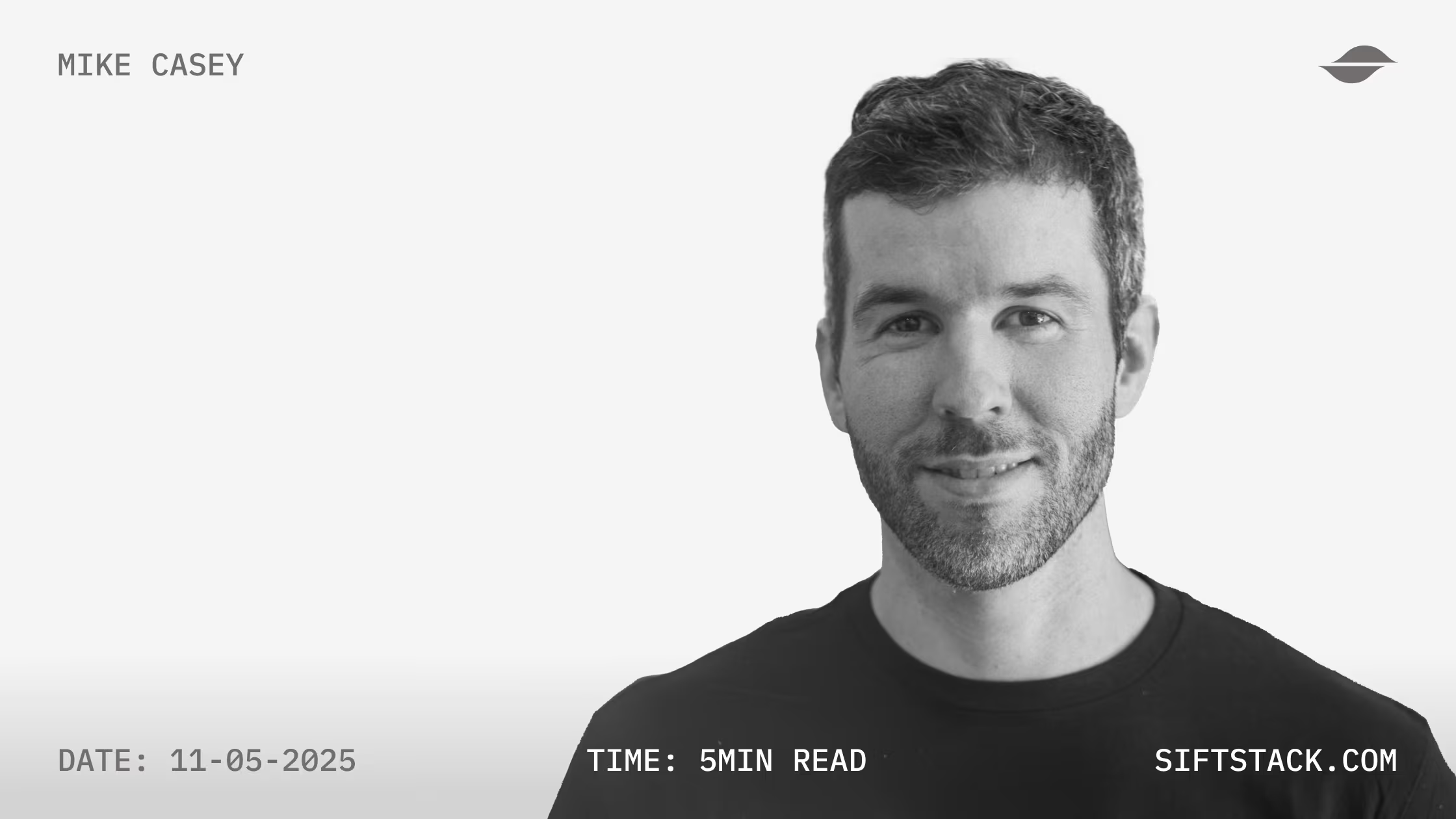
Mike Casey is a Deployment Strategist at Sift, where he works closely with aerospace customers to integrate tailored observability solutions into their test and launch operations. Before joining Sift, Mike spent nearly a decade as an intelligence analyst at the Defense Intelligence Agency, where he focused on Chinese space, satellite, and AI-enabled military capabilities. His Mandarin-language research and C4ISR expertise directly informed national security decisions and technology investments. At Sift, he’s traded policy reports for launch pads, working side by side with engineers to help hardware teams move faster and smarter.
The race to the moon
I spent years writing assessments and briefings to help shape long-term policy decisions. That work definitely matters, but I eventually wanted to be more involved in the results. I didn’t want just to study and analyze the new technology being created, I wanted to help make it.
I’d been watching the Aerospace area closely from a national security point of view, especially seeing China's rapid development in launch capabilities, satellite networks, and dual-use systems. Watching them test a moon lander and scale hypersonics programs brought urgency. The space race is real. The U.S. is still ahead in many ways, but we can’t assume it will stay that way. I joined Sift because we’re part of the solution, not in a policy paper, but with tools that teams use every day to build the future.
The “space race” today isn’t just a headline. It’s a real, present competition with strategic consequences. I wanted to be part of a group like Sift that helps the U.S. move quicker, move towards action.
I joined Sift because we’re part of the solution, not in a policy paper, but with tools that teams use every day to build the future.
Get close to the customer
Just two weeks after joining, I was already on-site with one of our customers, K2, watching them run integration tests. That immersion made the value of Sift feel very real. You’re not watching a dashboard update; you’re seeing engineers rely on it to make real-time decisions in a launch campaign.
You also learn what they actually do with the product versus what they say. Seeing that difference in practice helps you design better, suggest smarter defaults, or flag what really needs improvement.
Owning the outcome means owning the complexity
From my very first customer call, it was clear: Sift doesn’t just ship features, we align with our customers’ mission objectives. Internally, we call this “owning the outcome,” and it’s not just a cultural slogan. One of my customers has a goal to triple their launches. If that’s their goal, then it’s mine too.
What surprised me is how tailored each deployment really is. This isn’t off-the-shelf software. Every customer has different infrastructure, unique data pipelines, and their own operational constraints. Sift adapts to those differences by design.
To be a good partner, you have to go deep. That means understanding how your customer runs engine tests, how they debug anomalies, how their workflows actually function under pressure. You can’t fake it. You have to earn your way into their domain, and that’s what makes the work both challenging and meaningful.
What surprised me is how tailored each deployment really is. This isn’t off-the-shelf software. Every customer has different infrastructure, unique data pipelines, and their own operational constraints. Sift adapts to those differences by design.
A national security lens on engineering problems
I have real-world experience with national security use cases and a deep understanding of why advanced technologies matter to the warfighter. My background helps me identify the tactical and strategic importance of new capabilities and help our customers see tangible impact, whether it’s in enabling communications via new satellites or optimizing test processes for rapid deployment
If communications fail in the field, or if a satellite underperforms, it's not abstract. I know the second and third-order consequences. That makes me more attuned to how tools like Sift can close gaps, speed up post-test analysis, and give engineers a clearer view into what matters. My job now is to bring that urgency and context into the engineering process, where it can actually change the trajectory of a program.
A bias for action
I came from D.C., or “the beltway”, where everything takes forever and there are lots of rules and processes, so Sift is a nice change. For me, Sift is more about making fast choices, learning quickly, and moving ahead. We have a cultural value of “Bias for action” that emphasizes acting quickly and learning from outcomes. Making decisions swiftly, sometimes with incomplete information. All of this encourages rapid iteration and learning from mistakes. After starting, while reading Sift’s cultural values, I thought, “Wow, they really mean this. It’s not just words. People here can actually do things.”
Seeing your work land
When joining Sift, I wanted to do something more hands-on, and every week I learn something new, from software to aerospace tests. Also, seeing the impact. At Sift, I know when something I did helps a customer launch faster or avoid a costly issue. That kind of feedback loop is rare and energizing.
Review open career positions at Sift.


.avif)