.svg)

The interconnect queue choking our grid
The race for AI dominance and the expansion of mission-critical computing have hit a physical wall. Developing software takes weeks, but developing the physical infrastructure required to run software often takes years. Facing a dual crisis, organizations are stuck between (1) a legacy utility grid that cannot scale to meet high density power demands and (2) a desperate need to be able to monitor energy and compute systems at scale, as both such systems include hundreds of thousands of devices that rely on real-time observability.
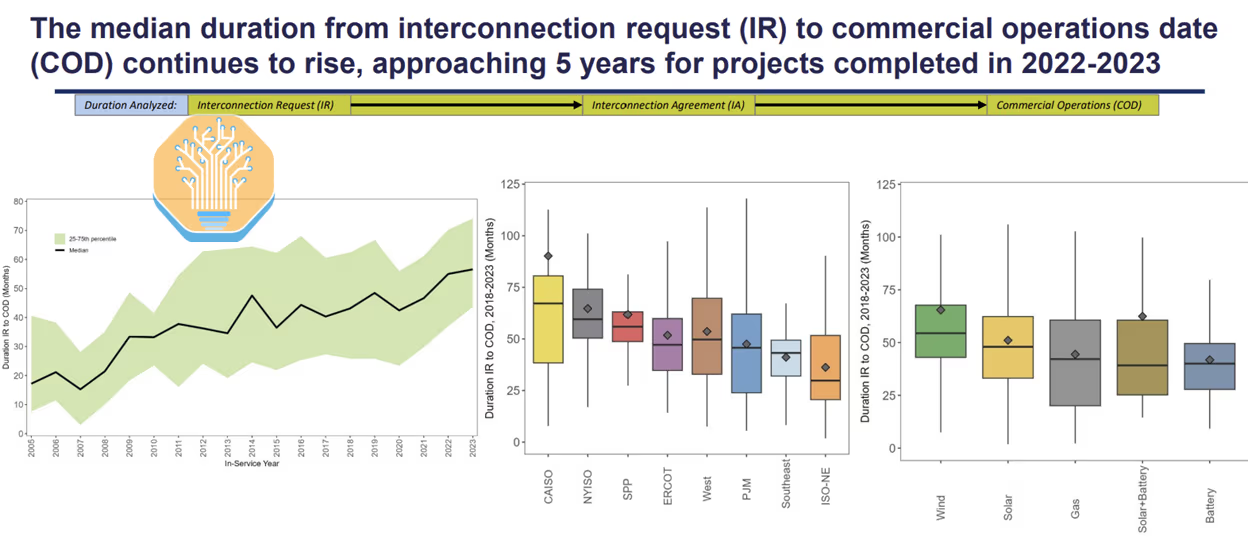
As of 2026, the American power grid is oversubscribed. Requiring impact studies and regulatory approval before they can be built, electric transmission system operators flounder in a years-long waitlist to connect to the US energy grid (hence interconnect queue). The situation has gotten so bad that some utility providers have stopped accepting new interconnect applications. This leaves data center operators in an unacceptable multi-year waiting list for electricity. When energy delivery is delayed and the system’s operational health is obscured by fragmented data, innovation stalls. Working together to eliminate these barriers, Voxel and Sift are powering next generation grids to unblock compute.
Unblocking AI’s energy constraints with Voxel’s energy infrastructure
Relying on traditional utility interconnect queue timelines can delay a project by five years on average (seven if you’re in California). Voxel Energy bypasses this bottleneck by delivering grid independent, direct current (DC) native energy infrastructure purpose-built for the specific demands of AI data centers.
Traditional power systems are trapped in a cycle of inefficiency. When solar, batteries, and computers (all DC components) are connected via an alternating current (AC) grid, they require at least five to six conversion stages. Each conversion stage generates heat and wastes energy, which increases energy use and total costs. Building a localized, DC native system from first principles, Voxel eliminates this conversion tax entirely. Whereas legacy approaches could lose as much as 30 percent of total energy flows due to conversions, Voxel’s technology only loses roughly 4 percent. If the entire American commercial sector adopted Voxel’s electricity approach, cost savings could run to almost $70 billion. By removing redundant components and monolithic failure points, Voxel delivers a more sustainable, reliable, and efficient energy supply.
Transforming Voxel’s grid with Sift’s analysis and predictive maintenance
But reliable power is only half of the equation. As AI data centers scale the number of devices involved, the volume of operational data they produce becomes overwhelming. AI workloads are notoriously volatile and power demand can surge by over 50 percent in a matter of seconds. Sift augments the inherent stability offered by Voxel's novel energy system by helping engineers gauge battery resilience characteristics based on real world data.
With features like automated data review and stateful analysis, Sift transforms raw telemetry into actionable insights. Unifying Voxel’s data from every layer of the stack, all the way down to individual battery cell modules, Sift creates a single source of truth. No more siloed data streams. This allows Voxel operators to validate the efficiency of the DC architecture and detect microscopic anomalies, such as subtle voltage drops or thermal drift. Like never before, teams like Voxel can service their physical hardware with the same agility as their software, all because of Sift.
Sift enhances Voxel's ability to predict and mitigate loss of capacity caused by aging batteries, maximizing performance and uptime.
- Max Pfeiffer, CTO @ Voxel Energy
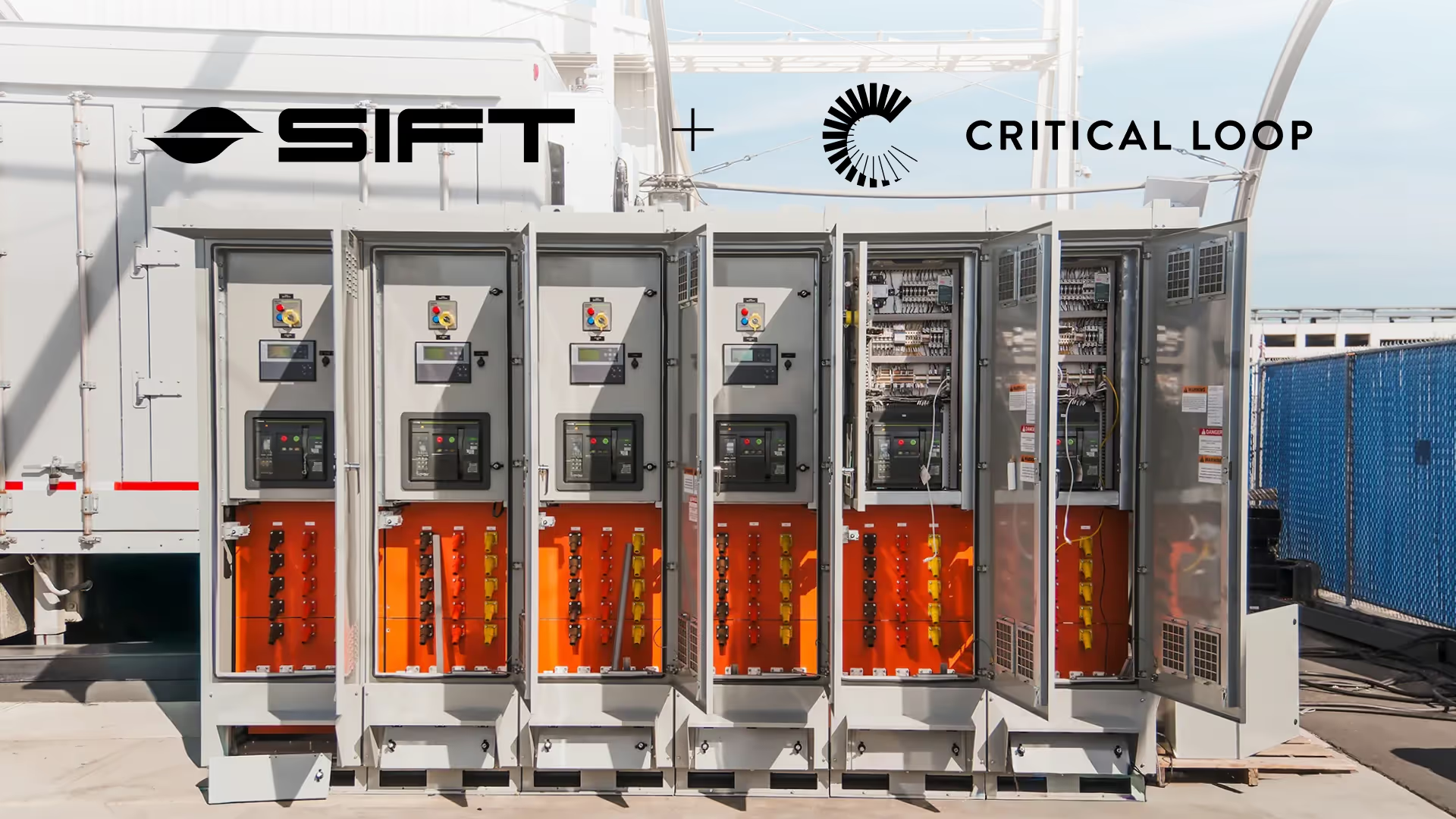
Accelerated by Sift, Voxel brings the first enterprise-grade, independent grid to market
For the modern enterprise, power that’s only "good enough" is a liability. Reliability is no longer measured in downtime hours, but in the granularity of data and the speed of response. By integrating Sift as the foundational observability layer of infrastructure, Voxel has moved beyond traditional hardware maintenance approaches to deliver a sophisticated, software-defined energy platform.
When Sift is deployed to a Voxel microgrid, it unlocks new capabilities that legacy monitoring platforms simply can’t compete with:
- Rapid time to power: Bypassing the interconnect queue, Voxel customers can move from a vacant lot to a powered, monitored data center in months, not years.
- Radical efficiency gains: Shifting to Voxel’s DC native architecture saves up to 26 percent of total energy consumption by eliminating the unnecessary AC conversion tax. For data centers requiring megawatts of energy, this could represent millions in cost savings on an annual basis. Across the entire American commercial market, that’s almost $70 billion per year.
- Instantaneous surge response: Sift helps Voxel detect spikes in energy demand in real time. Combined with the 5400 percent overhead on load rating made possible by Voxel’s energy architecture, massive AI training power ramps become inconsequential to system stability.
- Predictive asset longevity: Real-time tracking of every power component allows Voxel to conduct predictive maintenance and preempt failures months in advance, protecting capital investments.
- Total operational autonomy: Voxel customers no longer rely on a failing grid for power or a fragmented software stack for answers.
The future Voxel unlocks
Combining independent energy infrastructure capabilities with a best-in-class observability solution enables Voxel to build a world where AI compute is no longer constrained by legacy grids. The future of reliable, scalable compute will be determined by the successful integration of power generation and system intelligence. Why wait years for regulatory approval if data centers and its resulting progress can be realized in months? Instead of being constrained by the limits of bureaucracy or energy, innovation would only be constrained by the limits of imagination. For those building the technologies of the future, Voxel provides the energy to run and Sift provides the insight to lead. Whether you’re scaling a fleet of battery storage sites or deploying the next generation of AI data centers, Voxel’s unified approach with Sift ensures that Voxel’s infrastructure is not just powered, but optimized for the future.
Learn more about energy solutions HERE or get in touch with Voxel and Sift.