.svg)
Matthew Barr runs the continuous panel press pilot line at Plantd, a company that is building an automated, electric-powered manufacturing system and aims to vertically integrate its supply chain—from growing the grass to producing the final material—creating carbon-negative building materials that store more carbon than they emit.
Plantd uses Sift as their primary production telemetry monitoring system.
Until a few weeks ago, Matthew’s analysis loop looked like this: run a test, open Sift, find the run, export the channels to CSV, paste the data into Claude, run the statistics, make the graphs, write it up for the production team. Then repeat for the next run. The process took weeks.
"[Sift MCP] has changed how I work more than anything else I have picked up this year. The mechanical half of my job is gone, and I am spending my time on the part that actually needs an engineer."
Matthew Barr, Process Engineer, Plantd
Without Sift MCP
ONE POST TEST INVESTIGATION // 1 WEEK ~ 40 HRS
With Sift MCP
ONE POST TEST INVESTIGATION // 1 AFTERNOON ~ 3 HRS
Model Context Protocol gives your agent a direct route into Sift
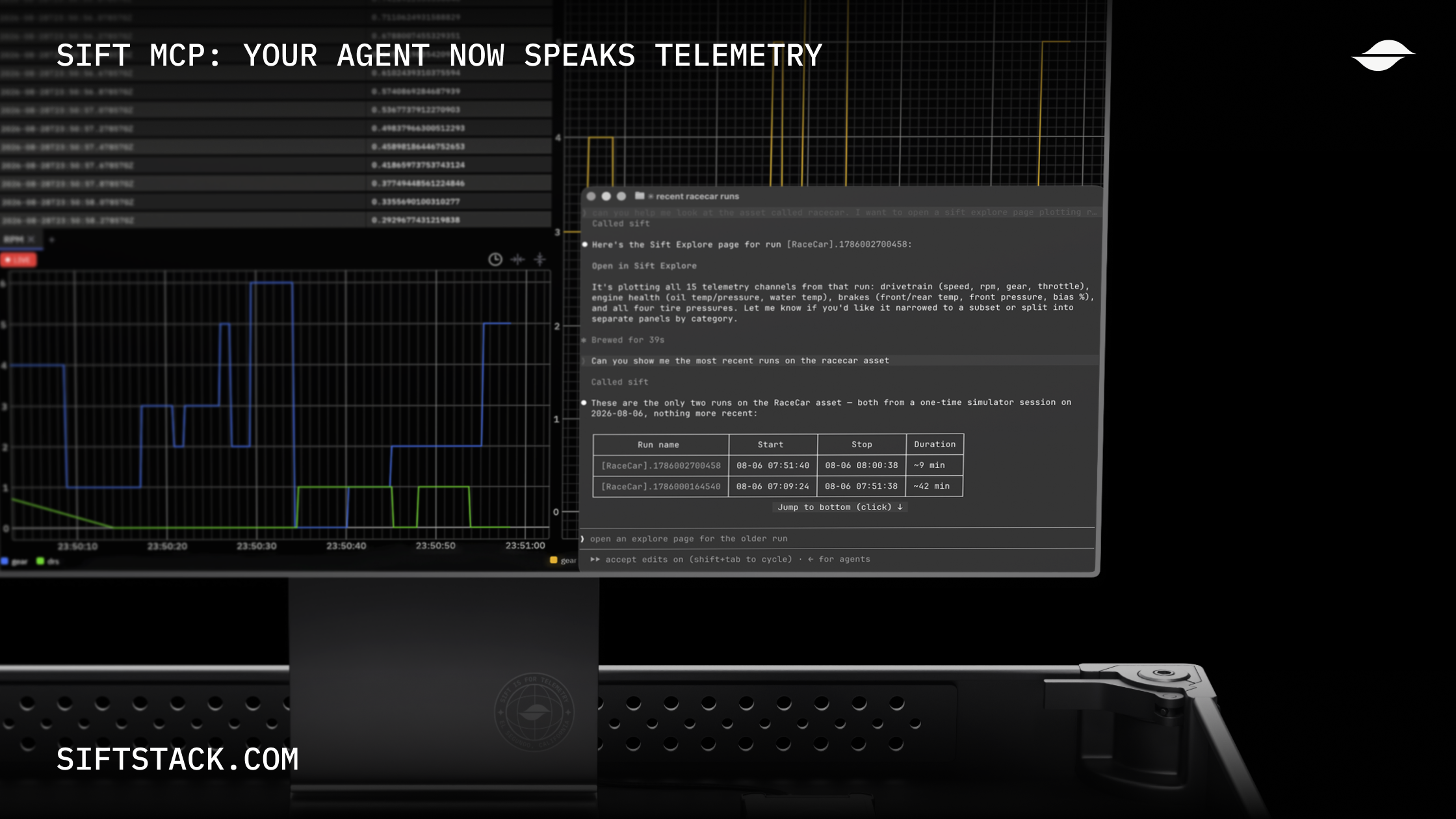
Model Context Protocol, or MCP, is the open standard that lets agents like Claude Code, Cursor, Codex, Copilot, Gemini, Antigravity and others work securely with outside systems. Sift MCP uses that standard to connect your agent to your telemetry and to Sift's hardware analysis interfaces: data discovery, transformations, visualization, and review workflows.
Install it once and the agent you already use can find runs, pull channel data, and run analysis against Sift directly. No exports, no copy and paste, no glue scripts. It's available to all customers and free with the platform.
Optimized for your existing workflow
Ask in plain language, "give me platen gap variance for every run this month," and the agent finds the runs, pulls the channels, and runs the analysis. Three layers make that work.
Tools built around your workflows.
A tool is an action the agent can take in Sift, and the set is deliberately curated: discover assets and channels, find runs, fetch data, run SQL, search the docs, and author rules and reports. Because each tool maps to a job you actually do, the agent picks the right one and reaches an answer in fewer steps instead of wading through hundreds of raw API endpoints.
Full coverage through the Sift clients.
The MCP is installed with the Sift CLI, so when a job falls outside the set of MCP tools, the agent can fallback on CLI interfaces that offer broad functionality coverage. The CLI offers other benefits, like the ability to switch between profiles to use different API keys.
Skills that carry the playbook.
Skills are working instructions the agent reads before it starts: how to structure an ingestion, how to handle errors, how to find the right channel without wasteful guessing. Ours encode the playbook our forward-deployed engineers built onboarding dozens of hardware programs, so the agent doesn't just have access to Sift, it knows how Sift is meant to be used.
Go further in every investigation
Speed is the first thing you notice and it compounds into real engineering velocity. In Matthew's first three weeks, Sift MCP handled 256 tool calls across 18 sessions and became his most-used agent integration.
Speed is worth having on its own. What matters more is that it changes which questions get asked at all.
"The part I did not expect is that I ask more questions now. When it took me half a day to get an answer, I only asked the questions that were worth half a day. Now if I want the median instead of the average, or I want to throw out the startup transient, or I want to add 3 more runs to the comparison, it's one sentence. So I end up at better answers, not just faster ones."
Matthew Barr, Process Engineer, Plantd
Plenty of investigations never reach a root cause because ruling out every candidate would take weeks of manual effort nobody can afford. Sift MCP makes those questions cheaper to answer. Does dosing variance predict panel mass variance? Does mat thickness at the former predict stiffness failures downstream? Does a low-density run eat more material per board? Investigations are bounded by your curiosity, not your schedule.
So how does Sift MCP accelerate a workflow that previously took days or weeks?
Compounding insights accelerate the next round of testing
Most analysis today happens ad hoc, and repeating it means several manual steps that are easy to forget. Even when you get the answer, a month later nobody can find it, rerun it, or build on it.
Sift MCP compounds your analysis by accumulating insights in the system of record, instead of leaving them siloed in one engineer's chat history. It does this by steering agents to save useful results back into Sift as the objects you already work with: Rules, Reports, Annotations, and Calculated Channels. It can also return a link into Sift Explore so another engineer opens the same signals over the same time range.
Skills accelerate this further. Matthew packaged a recurring analysis, pull these channels, run these stats, join the quality data, output the review in Plantd's format, into a custom skill. Every run after that is one sentence instead of a session of back and forth.
"I don't really do manual data analysis anymore. This is saving me dozens of hours a week, easily."
Matthew Barr, Process Engineer, Plantd
Built-in governance for complete peace of mind
Sift’s customers build critical machines. So we designed Sift MCP to answer the security and governance questions you will have before an agent goes anywhere near production telemetry.
What permissions does the agent have? The server runs on your machine and reads the endpoint and API key from your Sift CLI profile. Every call reaches the existing Sift API, where that key's permissions apply. The agent cannot read data or make changes that you could not.
What can the agent change? Out of the box, nothing. Tools that modify or archive existing resources stay disabled until you restart the server with an explicit --allow-destructive flag, and no tool can delete your data. Archive actions are reversible and stand in for delete. Every tool declares whether it reads or writes, so hosts like Claude Code ask for your approval before a write runs, and the installed guidance has the agent confirm the target, the proposed values, and the environment first.
Can it overload my instance? No. Queries are capped, and the server backs off on rate-limit signals instead of retrying into them.
If your compliance posture means data cannot reach a local agent at all, we're building Sift Agents, hosted and orchestrated inside the Sift platform, for exactly that use case. Contact us to learn more.
Install Sift MCP and ask your first question
Sift MCP is available to all customers today. The tool set is expanding and already being shaped by user feedback.
Follow the setup guide for the agent you already use, then start with a question you ask often. Soon you'll find yourself discovering more.