.svg)
Supersonic passenger flight didn't disappear because it was impossible. It disappeared because it was expensive. Every jet engine ever flown makes the same compromise: pick one speed, be efficient there, and pay for it everywhere else. Astro Mechanica refused that compromise. In their engine, electric motors drive the compressor independently, so the engine adapts across every flight regime from subsonic through supersonic, and it burns liquefied natural gas at a fraction of the cost of jet fuel. Fix the engine, and the economics of supersonic flight follow.
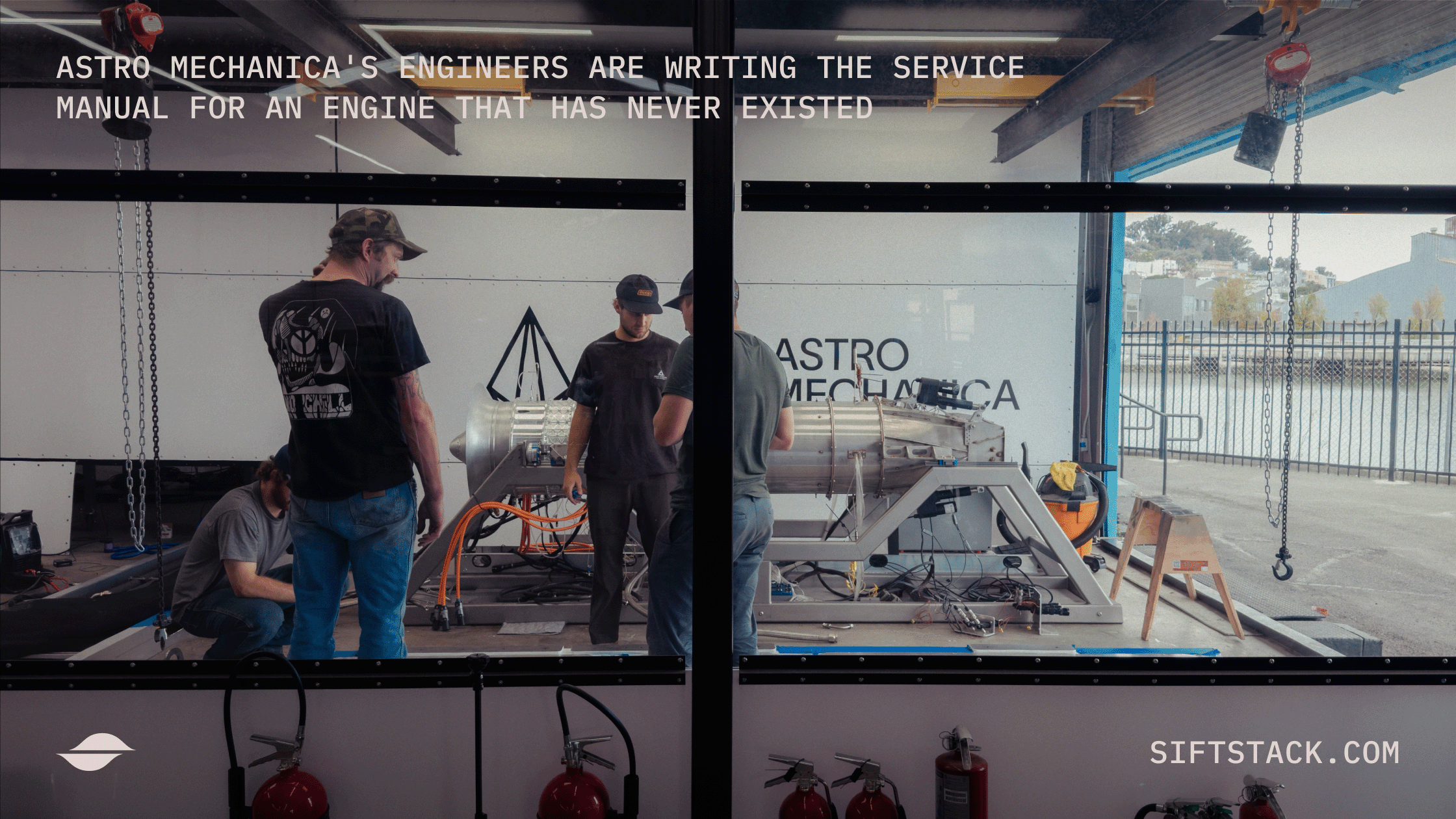
Inventing an engine means nobody can tell you what normal looks like. There is no service manual, no industry baseline, no decades of fleet data to lean on. The only manual that will ever exist is the one the engineers write themselves, one test at a time.
Astro Mechanica has been writing their manual, fast. Since October 2024, they’ve logged 1,959 engine tests, a pace of multiple tests every working day for nearly two years, across four engine generations and the stands that support them: 18 instrumented assets carrying 49,246 sensor channel records. The median test lasts 42 seconds. For that burst, between 2,600 and 3,900 channels wake up at once, each sampled at a uniform 100 Hz. That is how a program this young has already recorded roughly 264 billion samples. Everything that decides a test happens in less time than a song, and none of it gets a second take.
Astro Mechanica is hiring engineers to help build the engine that changes what flight costs. See their open roles.
Rebuild the engine, and the old analysis breaks
A first-of-its-kind engine never sits still. Hardware iterates between generations, sensors move, channel names drift, and third-party components arrive speaking their own naming conventions. For a long time, all of that drift landed on the analysis code. Python scripts crashed when a channel name didn't match exactly. Config files were rebuilt by hand for each stand configuration. A single failed plot kicked off a debug loop, and one investigation cycle ran anywhere from a few minutes to a couple of hours. Comparing runs multiplied the work, and hardware differences between runs got papered over by commenting out code.
The deeper cost was concentration. The knowledge of how the engine behaved lived in whoever wrote the scripts. For a program moving this fast, that was the real exposure. Not losing the data. Losing what the data had already taught them, every time the hardware changed.
Encode the physics once, apply it to every run
Today, test data lands in Sift automatically at the end of every sequence. Capturing the raw record is the easy part. What changed the program is where the analysis lives. Astro Mechanica's engineers encoded the physics itself into the platform, station by station through the engine, from compressor to motors to combustor to nozzle to thrust.
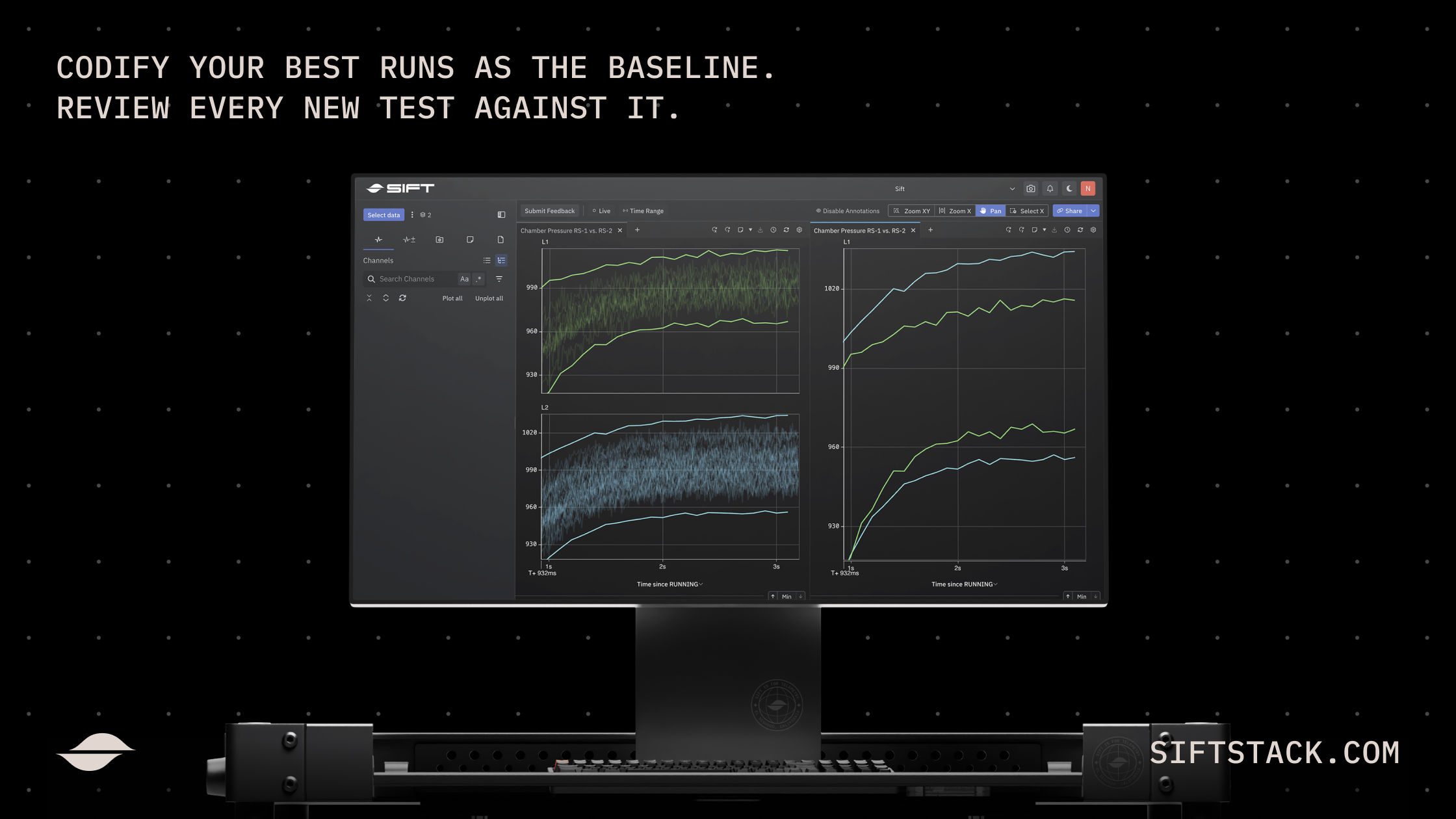
[A Sift Explore view of a 42-second engine test, plotted moments after the run ends]
Astro's engineers compute engine performance directly on the raw telemetry, the moment a run ends, using Calculated Channels. They pushed the harder aerothermodynamics, the isentropic flow relations that derive Mach number from pressure ratios, gas velocity, and temperature recovery, into their own User-Defined Functions. When a cross-channel median they needed this August didn't exist yet, they wrote 13 new functions in 48 hours on the same expression system, including a family of range-gated medians that vote a failed sensor out of the answer automatically.
Their library now holds 226 calculated channels, and it behaves nothing like a config file somebody set up in 2024 and forgot. 82% of it has been revised past version one, because the hardware keeps changing and the math keeps up. One channel is on revision 68: sixty-eight times the engine evolved underneath it, and sixty-eight times the definition moved with it instead of breaking. These channels bind to the engine, not to a single test, so the math gets written once and applies to every future run. No exceptions, no forgetting. 85 of the 226 already do double duty across more than one engine.
[The calculated channel library, versioned like the hardware it describes]
"It's just no-headache problem solving. The pitch from Sift, and what we've experienced so far, is simple: the thing is going to work. Put your data in, and you can do what you need with it."
Matt Perkins, Engineering Lead, Astro Mechanica
Stand up a new engine, keep everything the last one learned
Here is what a generation change used to mean for a hardware team: the scripts break, the channel maps get rebuilt by hand, and analysis slows to a crawl at exactly the moment the program can least afford it.
In March 2026, Astro Mechanica stood up its fourth-generation engine, and the opposite happened. The team ran 420 tests in a single month, 2.6 times their fastest pace ever, because the analysis was already waiting for the new hardware. They wrote 152 new calculated channels that month, 62 of them spanning multiple engines from the moment they were created, and more engineers worked in the data than in any prior month of the program. Plotting activity in Explore tells the adoption story on its own: from a standing start to 399 plotting events in March, then 1,786 in April. April is also the month that shows what the backend quietly absorbed: 93.9 billion samples, more than a third of everything the program had ever recorded, landed in 30 days without anyone stopping to re-architect a thing.
Five months later, they did it again, faster. Their newest engine came online in August 2026 and was fully instrumented in six days: 51 runs, 50 new calculated channels, and 30 billion samples in the first week. The detail that proves the whole thesis sits inside that number. 22 of those 50 channels were born spanning two engine generations, reading the new hardware against the old from their very first run. Nobody rebuilt the playbook. The playbook was already there, waiting.
The team grew with the record. Four monthly active users became 17 over 18 months, and shared chart links now get opened around 150 times a month as results move through the team, a link doing the job a hand-me-down Python script used to do. Four engine generations, one record, zero resets.
Run the whole test program on one platform
The shift was not a single feature. It was the engine's entire behavioral record, and the math that interprets it, living on one platform that outlasts any single test, script, or hire.
Carry 226 channels of engine math onto every future run automatically, across four generations and counting, because Calculated Channels bind to the asset instead of a single test.
Keep the team's aerothermodynamics as named, versioned expressions anyone can call by name, never as formulas buried in scripts that break on a rename, inside User-Defined Functions.
Compare runs at full fidelity, overlaying a 42-second test at 100 Hz on one timeline that holds at every zoom level without the detail averaging away, by aligning them to a shared T-0.
Give subsystem partners exactly the channels they need and nothing else, so data moves through the supply chain without exposing the engine, through attribute-based access control.
Move data in and out without a single custom parser, importing HDF5 and TDMS and exporting Parquet, with the Sift CLI.
Push the platform to its ceiling, and the ceiling moves
Astro Mechanica's engineers don't use Sift gently. They chain calculations until they find the ceiling, then tell us exactly where it is. The release notes track that pressure, month by month, right alongside their test campaign.
In November 2025, they were live-firing daily. By December, Calculated Channels that reference other Calculated Channels shipped in beta, turning their deepest engine math into modular chains, alongside a Scatterplot Panel for hunting correlations across signals. January brought collaborative analysis and data portability. In March, as the fourth-generation engine ran 420 tests, data export, per-channel downsampling, relative-time alignment, and Annotations in Explore all landed. In April, nested Calculated Channels went GA alongside a rebuilt Explore workspace and the ability to feed any Calculated Channel into Rule logic, the same month plotting activity more than quadrupled. In May, attribute-based access control arrived along with statistical baselines built from related runs, and vendor partners got scoped access to subsystem data. In July, Saved Explorations made the team's views reusable across runs, assets, and families, and Sift CLI v0.2.0 brought HDF5 and TDMS straight into the platform.
When the engineers hit a limit in the platform, the limit moved.
Move the knowledge out of scripts, and the speed compounds
A team that invents hardware ends up with two things: the machine itself, and the knowledge of how it behaves. The hardware gets all the care. The knowledge usually lives in scripts and spreadsheets, and every new hardware generation quietly breaks them. Names drift, config files rot, and what the program has learned ends up in the head of whoever wrote the tooling.
Astro Mechanica moved that knowledge out of the scripts and into a record bound to the engine itself, early, while the program was still small. Four generations later, the math has outlived every hardware change and a test cadence that jumped 2.6x in a single month, and every new engine starts with everything the old ones learned.
The engine is the invention. The manual for how it behaves is being written with the same care, 264 billion samples and counting, one 42-second test at a time.
See how Sift keeps your test program's knowledge in one place from the first bench run forward. Get a demo.
"It's just no-headache problem solving. The pitch from Sift, and what we've experienced so far, is simple: the thing is going to work. Put your data in, and you can do what you need with it."
Matt Perkins, Engineering Lead, Astro Mechanica
Stand up a new engine, keep everything the last one learned
Here is what a generation change used to mean for a hardware team: the scripts break, the channel maps get rebuilt by hand, and analysis slows to a crawl at exactly the moment the program can least afford it.
In March 2026, Astro Mechanica stood up its fourth-generation engine, and the opposite happened. The team ran 420 tests in a single month, 2.6 times their fastest pace ever, because the analysis was already waiting for the new hardware. They wrote 152 new calculated channels that month, 62 of them spanning multiple engines from the moment they were created, and more engineers worked in the data than in any prior month of the program. Plotting activity in Explore tells the adoption story on its own: from a standing start to 399 plotting events in March, then 1,786 in April. April is also the month that shows what the backend quietly absorbed: 93.9 billion samples, more than a third of everything the program had ever recorded, landed in 30 days without anyone stopping to re-architect a thing.
Five months later, they did it again, faster. Their newest engine came online in August 2026 and was fully instrumented in six days: 51 runs, 50 new calculated channels, and 30 billion samples in the first week. The detail that proves the whole thesis sits inside that number. 22 of those 50 channels were born spanning two engine generations, reading the new hardware against the old from their very first run. Nobody rebuilt the playbook. The playbook was already there, waiting.
The team grew with the record. Four monthly active users became 17 over 18 months, and shared chart links now get opened around 150 times a month as results move through the team, a link doing the job a hand-me-down Python script used to do. Four engine generations, one record, zero resets.
Run the whole test program on one platform
The shift was not a single feature. It was the engine's entire behavioral record, and the math that interprets it, living on one platform that outlasts any single test, script, or hire.
Carry 226 channels of engine math onto every future run automatically, across four generations and counting, because Calculated Channels bind to the asset instead of a single test.
Keep the team's aerothermodynamics as named, versioned expressions anyone can call by name, never as formulas buried in scripts that break on a rename, inside User-Defined Functions.
Compare runs at full fidelity, overlaying a 42-second test at 100 Hz on one timeline that holds at every zoom level without the detail averaging away, by aligning them to a shared T-0.
Give subsystem partners exactly the channels they need and nothing else, so data moves through the supply chain without exposing the engine, through attribute-based access control.
Move data in and out without a single custom parser, importing HDF5 and TDMS and exporting Parquet, with the Sift CLI.
Push the platform to its ceiling, and the ceiling moves
Astro Mechanica's engineers don't use Sift gently. They chain calculations until they find the ceiling, then tell us exactly where it is. The release notes track that pressure, month by month, right alongside their test campaign.
In November 2025, they were live-firing daily. By December, Calculated Channels that reference other Calculated Channels shipped in beta, turning their deepest engine math into modular chains, alongside a Scatterplot Panel for hunting correlations across signals. January brought collaborative analysis and data portability. In March, as the fourth-generation engine ran 420 tests, data export, per-channel downsampling, relative-time alignment, and Annotations in Explore all landed. In April, nested Calculated Channels went GA alongside a rebuilt Explore workspace and the ability to feed any Calculated Channel into Rule logic, the same month plotting activity more than quadrupled. In May, attribute-based access control arrived along with statistical baselines built from related runs, and vendor partners got scoped access to subsystem data. In July, Saved Explorations made the team's views reusable across runs, assets, and families, and Sift CLI v0.2.0 brought HDF5 and TDMS straight into the platform.
When the engineers hit a limit in the platform, the limit moved.
Move the knowledge out of scripts, and the speed compounds
A team that invents hardware ends up with two things: the machine itself, and the knowledge of how it behaves. The hardware gets all the care. The knowledge usually lives in scripts and spreadsheets, and every new hardware generation quietly breaks them. Names drift, config files rot, and what the program has learned ends up in the head of whoever wrote the tooling.
Astro Mechanica moved that knowledge out of the scripts and into a record bound to the engine itself, early, while the program was still small. Four generations later, the math has outlived every hardware change and a test cadence that jumped 2.6x in a single month, and every new engine starts with everything the old ones learned.
The engine is the invention. The manual for how it behaves is being written with the same care, 264 billion samples and counting, one 42-second test at a time.
See how Sift keeps your test program's knowledge in one place from the first bench run forward. Get a demo.