Every mission to space eventually has to answer the same question: will this hardware still work after it leaves Earth? For decades, that question belonged mostly to government programs with dedicated radiation groups, long schedules, and parts built for space. Today, a growing number of commercial teams build spacecraft around components that were never designed for radiation. The need to qualify hardware for space radiation has not changed. But the number of teams needing qualification results in a timely manner has.
Radiation engineering is a highly specialized discipline. Our founder, Merek Chertkow, led radiation efforts at SpaceX and Blue Origin before starting The Rad Team to make that experience available to missions across the industry. The goal is to lower the barrier to accessing and operating in space, with radiation analysis and testing tailored to each mission.
Radiation Engineering is one of the major barriers to space exploration. Our careers at private space companies focused on solutions toward ‘their’ goals, but didn’t feel like the best path towards moving the industry forward. We want to help the proliferation of space for all, so we started The Rad Team and surrounded ourselves with like-minded individuals, all of which are experts in their field. Working together as an entire space ecosystem, we all will get farther and do more for humanity.
-Merek Chertkow (Founder)
In practice, we help teams decide what to test, when to test it, and how to test it without breaking a program's schedule or budget. That work starts with existing radiation evidence. When new testing is needed, we use Sift to organize the recordings, investigate events, and keep findings tied to the measurements behind them.


What radiation qualification involves
Radiation qualification shows that a part, board, or system will survive its mission's radiation environment for as long as the mission needs it. NASA calls the discipline radiation hardness assurance. It is not a single test but a cycle of engineering decisions:
- Define the environment. Orbit, altitude, inclination, mission length, solar activity, and shielding all shape what a spacecraft will see. A short mission in low Earth orbit faces a very different dose than a long one in geostationary orbit.
- Screen the parts list. Engineers rank each component by risk, starting from existing test data.
- Weigh criticality. Not all failures are created equal. A bit flip in a payload buffer and a latch-up in a power controller represent very different mission risks.
- Conduct testing. Once critical parts are identified, it's time to get a test plan and time at a radiation source going. The right source depends on the effect being tested and the mission environment.
- Check margin and decide. Test results inform on-orbit rate predictions and a radiation design margin: the part's failure level divided by the mission's specified radiation level. Thin margin calls for mitigation, more testing, or a different part.
The cycle repeats as designs and part choices change. Most of the testing work addresses three kinds of effects:
- Total ionizing dose (TID): cumulative, long-term degradation as a result of trapped radiation over a mission’s lifetime. Some bipolar and linear parts degrade more at the low dose rates of space than in fast lab tests, so test conditions matter.
- Single event effects (SEE): disruption or damage caused when a single ionizing particle strikes a sensitive piece of equipment. Effects range from a flipped bit to latch-up, which can destroy a part unless current is limited, to burnout or gate rupture in power devices.
- Displacement damage dose (DDD): cumulative structural degradation to a material from radiation exposure. It matters most for optoelectronics, image sensors, solar cells, and linear bipolar parts.
Test too little and the mission carries risk it can't account for. Test too much and a program spends money and months it doesn't have.

Working through the test data
A single test records a part's voltage and current thousands of times a second, adding up to millions of readings. A brief disturbance can matter even when the component appears to behave normally throughout the rest of the test. We examine those recordings and keep the evidence behind our findings available for review.
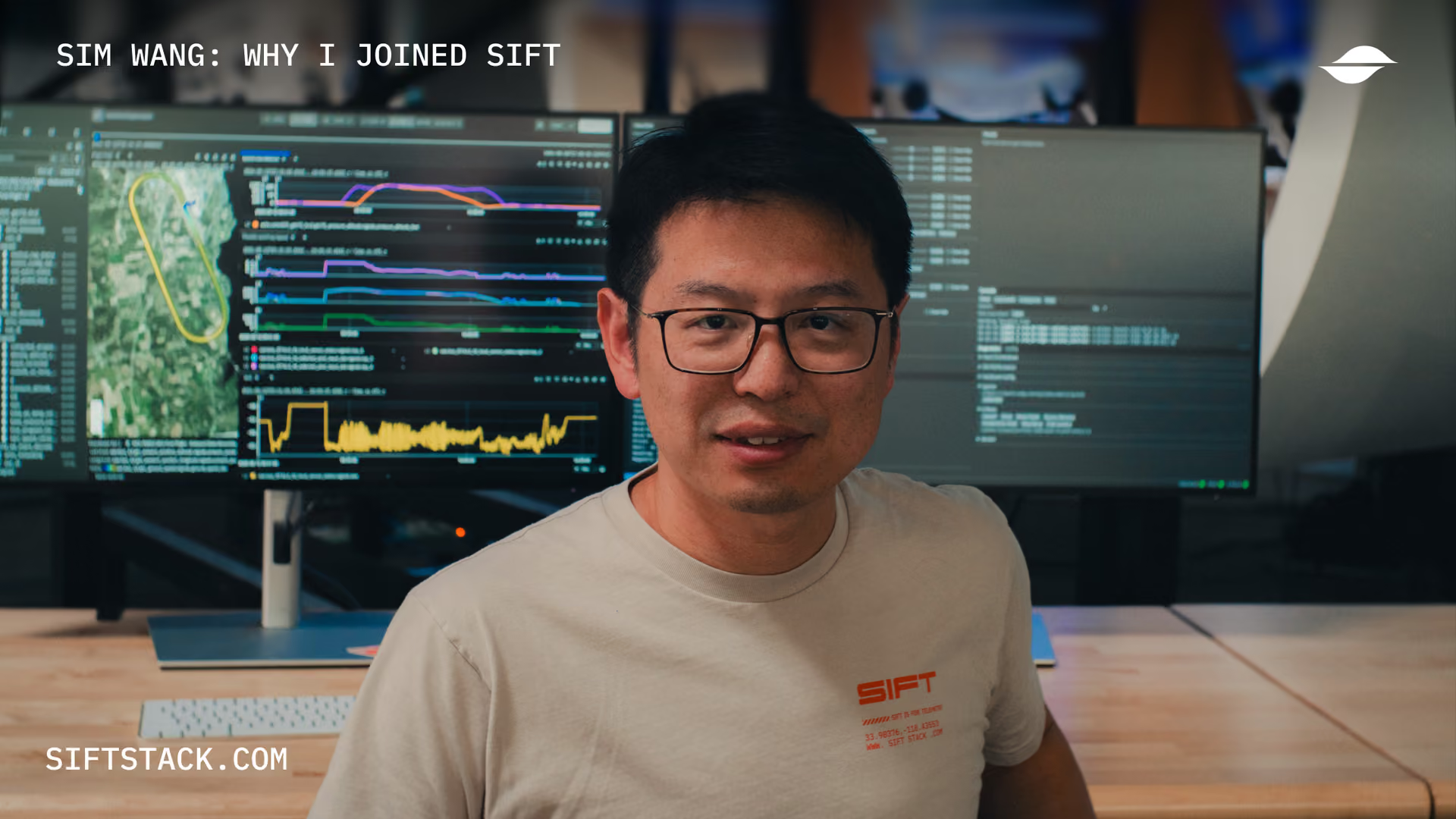
We upload test files into Sift, organize the measurements by component, and add searchable information about the test. Engineers can examine graphs of the full recording, then zoom into a short interval to investigate a change. If a voltage briefly drops, for example, they can look at current and other measurements from the same period to understand what happened around it.

Before testing, our engineers can prepare rules that define the behavior they want to investigate, such as the voltage range a part should hold. We apply those rules to the recorded data after the test. Sift flags periods outside the specified limits, directing engineers to relevant moments within a recording that may contain millions of readings. Multiple rules can check different measurements or conditions in the same test.
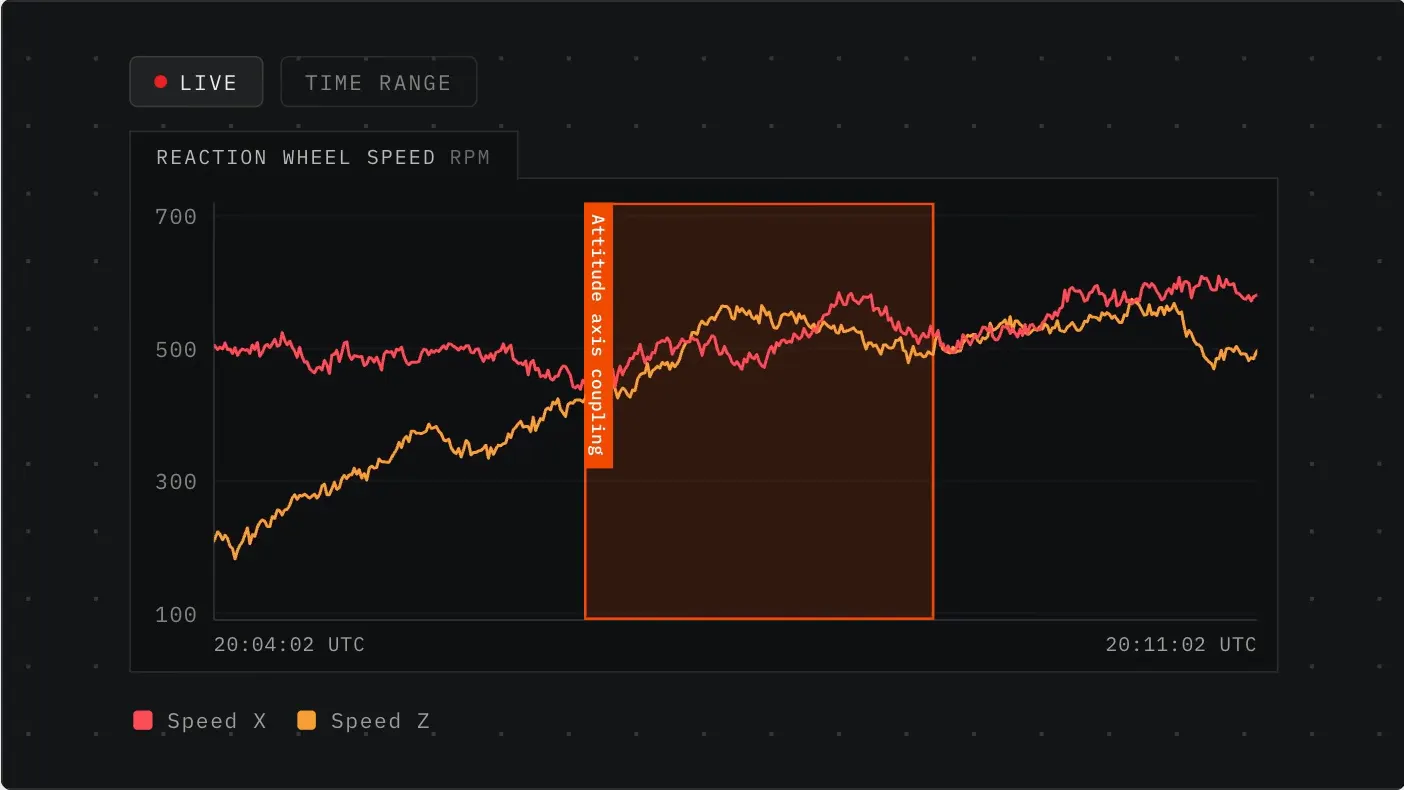
Our engineers review the flagged events and decide what they mean. An unusual reading might indicate a component problem, an expected change during the test, or something that needs further investigation. Annotations attach a name and explanation to a point or period in the recording, keeping the finding connected to the measurements behind it. We use both automatically generated annotations and notes added manually during analysis, and engineers can update those notes as their understanding develops.
Those findings carry into our customer reports. Engineers can export annotation details, including an event's time, name, and description, and use the underlying measurements to explain their conclusions. Sift supports the evidence review and documentation; our engineers supply the radiation expertise and make the qualification judgments.
Testing capacity for radiation is limited
Heavy ion testing requires access to a particle accelerator, and demand exceeds the available time. A 2024 study conducted by The Rad Team under a Department of Defense contract estimated annual demand from government and commercial space programs at 20,000–25,000 hours. The combined capacity available from Texas A&M University, Lawrence Berkeley National Laboratory, NSRL, and Michigan State University was estimated at 6,000–8,000 hours a year.
The Rad Team works with these facilities regularly and maintains strong relationships with their teams. That ongoing coordination helps us secure beam time, while our proprietary test methodology helps us use those hours efficiently. Planning starts well before we arrive at the accelerator.
For teams that approach radiation testing only when a specific need arises, securing a test date and allowing enough preparation time can be difficult. A campaign may require three months of preparation for one or two days of testing, followed by weeks of data analysis. Commercial components can add preparation steps: plastic packages may need to be opened, and flip-chip parts thinned, so ions can reach the silicon. Those requirements need to be understood before beam time is booked.
The data needs the same advance planning. Engineers need to know what to measure, how measurements will line up, and what behavior warrants investigation. Sift supports that workflow: we can prepare analysis rules before testing, organize and compare recorded measurements, and keep post-test findings connected to the evidence behind them. Getting the data aligned correctly the first time helps us make the most of a limited test window and gives engineers a usable record for analysis and customer reporting.

Commercial components add to the testing bottleneck
Commercial demand adds to an already limited supply. Commercial teams increasingly send payloads to space, often built with commercial off-the-shelf (COTS) components instead of radiation-hardened parts. COTS components are cheaper, faster to buy, and often more capable. But, they also come with no radiation guarantees. Manufacturers are not always required to tell customers about design changes and results can also vary from lot to lot of the same part number. NASA radiation hardness assurance researchers summarized the tradeoff: moving to COTS "may reduce direct costs and procurement lead times," but "it undermines many cost-reduction strategies used for conventional radiation hardness assurance".
That shifts the burden of radiation testing to the teams building spacecraft: more parts to evaluate, less flight heritage, and commercial schedules. Problems found late can force a board redesign, a slipped launch, or repeated qualification work.
Thankfully, not every commercial part needs a full test campaign. The answer depends on the mission, the part's function, the available margin, and what design can mitigate through shielding, current limiting, error correction, or redundancy. The Rad Team helps teams define the minimum viable qualification effort: what must be tested, what analysis or design can cover, and where custom hardware makes more sense than qualifying a part that was never a good fit.

Not starting from zero
Much of today's radiation testing has already been done in some form, with results in conference papers, government reports, or supplier studies. The hard part is finding them. Proprietary reports, classification, and unsearchable PDFs mean every new company risks paying to relearn what someone else already figured out.
NASA has long supported public databases of test results, including reports from its Electronic Parts and Packaging Program. But free resources also rarely cover the breadth of parts commercial programs now use.
We built the Radiation Parts Database to put that same mission into practice: making existing radiation evidence easier for other teams to find and use. It combines previously published SEE, TID, and DDD data with results from our own campaigns. Engineers can search by part number, manufacturer, or feature and build a parts list. Public reports are free, and reports from our own testing are available for purchase.

Existing data only helps when it matches your part and your mission. European space standards accept existing total dose data only when the tested parts share the flight parts' process, diffusion mask, and wafer fab. When lots differ and the margin is below a factor of two, the standard calls for testing the flight lot. Our engineers can check that applicability for you. Used correctly, existing data can rule out a test, narrow its scope, or point to exactly what to test next. Missing data proves nothing, though. As JPL notes, absence of data "should not be interpreted as evidence of radiation tolerance".
We also test components the industry needs before a customer asks, so a ready report can replace a long lead time campaign.
The same approach carries into our own campaigns: we organize the test recordings, investigate flagged events, and keep our conclusions connected to their supporting measurements.
Proprietary customer results stay proprietary. Where it makes sense, we aim to be a vehicle for exchanging that knowledge across the industry, because a shared baseline shortens development cycles for everyone.
Start with what is already known
What teams control is when they learn what radiation will do to their hardware. Learning early means a design choice. Learning late means a redesign. Start from what is already known, so you only pay to test what is new.
Search the Radiation Parts Database, or talk to our engineers about scoping your next qualification effort before radiation becomes a schedule, cost, or mission problem.


Merek Chertkow
Founder and CEO
The Radiation Team